
Quick Answer: Cricut Pricing Formula
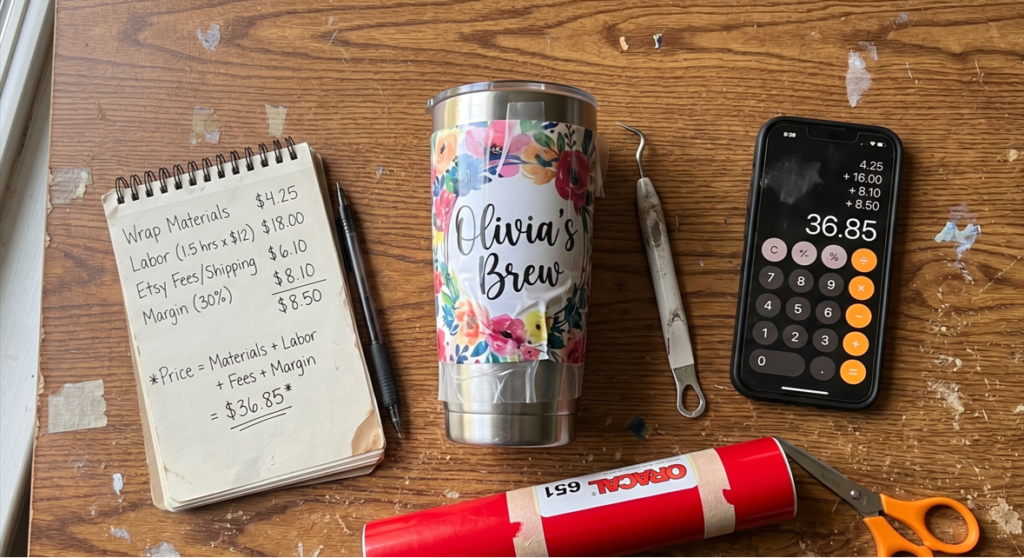
- Use a cricut pricing formula: Materials + Labor + Overhead + Fees + Profit Margin = Your Price
- Never price from what you’d personally pay. Price from what it actually costs you to make and deliver.
- Pay yourself for your time. If you don’t, you’re not running a business — you’re running a charity.
- A reliable handmade pricing formula for beginners: (Materials x 3) + Labor + Fees. Adjust the multiplier up for custom or one-of-a-kind work.
- Common mistakes include forgetting packaging costs, copying competitor prices, and cutting prices out of fear.
- Do the math before you take another order. Every time.
Someone texts and asks how much for a set of personalized tumblers. You need a number. You don’t have one ready. You think about what you’d pay. You think about what seems “fair.” You think about whether they’ll say yes or no. You type a number that feels safe and hit send.
That’s not how to price Cricut orders. That’s guessing. And guessing produces two outcomes: you underprice the work and resent the order, or you overprice it without knowing why and panic when the customer pauses. Neither one is a pricing strategy.
Most people who make Cricut products for money start the same way. They arrive at a number the same way. And they wonder, every single time, whether they got it right. The answer’s almost always no, and not because they charged too much.
The Quick Answer: Pricing Is Math, Not a Feeling
A cricut pricing formula takes the guesswork out of the decision. It doesn’t guarantee every customer will say yes. It does guarantee you’ll know exactly what you need to charge to cover your costs and pay yourself for the time you spent.
The formula is:
Materials + Labor + Overhead + Fees + Profit Margin = Your Price
That’s your handmade pricing formula. It applies to tumblers, decals, shirts, personalized gifts, wedding favors, and every other Cricut product you make. The numbers inside the formula change by product.
Pricing from feelings produces inconsistent results. Pricing from a formula produces a number you can defend, repeat, and build a real business on.
Breaking Down Each Component of the Cricut Pricing Formula
1. Materials
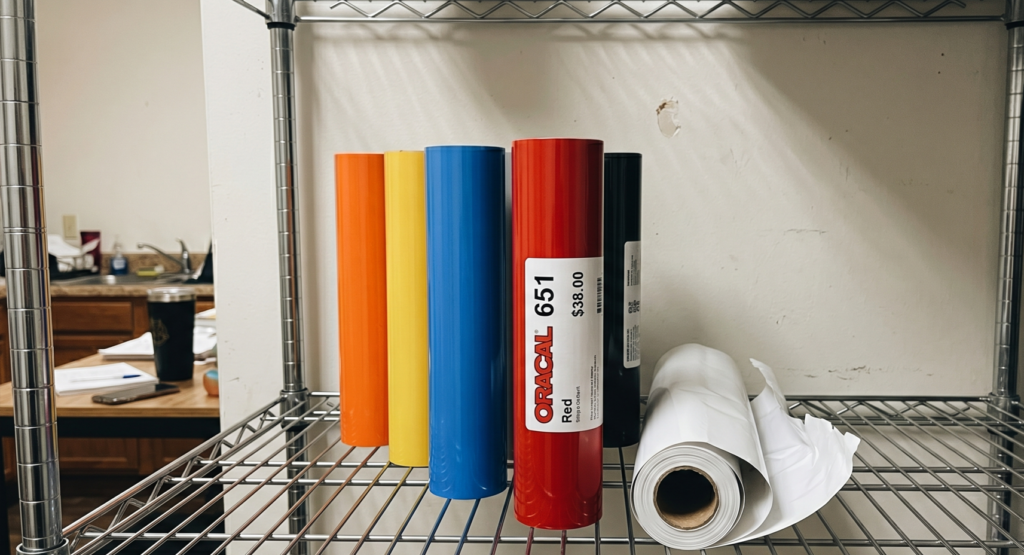
This is the actual cost of every physical input that goes into one finished product. For a custom tumbler, that means the blank tumbler, the vinyl, the transfer tape, and any packaging material. Write down every item. Look up the unit cost. Add them up.
If you bought a 50-pack of tumblers for $75, each blank costs $1.50. If a vinyl roll cost $12 and covers 20 tumbler wraps, that’s $0.60 in vinyl per tumbler. Transfer tape, roughly $0.15. That’s $2.25 in materials for one tumbler, before you’ve touched the machine.
Most people who are working out cricut pricing for beginners undercount materials on the first pass. They forget the pen cartridge, the shipping they paid on the blank order, the extra vinyl they ruined while calibrating the cut. Account for waste. A 10–15% materials buffer is reasonable.
2. Labor and Time
This is where how to price Cricut orders breaks down for most people. They forget to count themselves.
Decide what your time is worth per hour. $15 is the floor. $20 to $25 is more realistic for skilled custom work. Track how long the order actually takes: design time, cutting time, weeding time, pressing or applying time, and packing time. All of it.
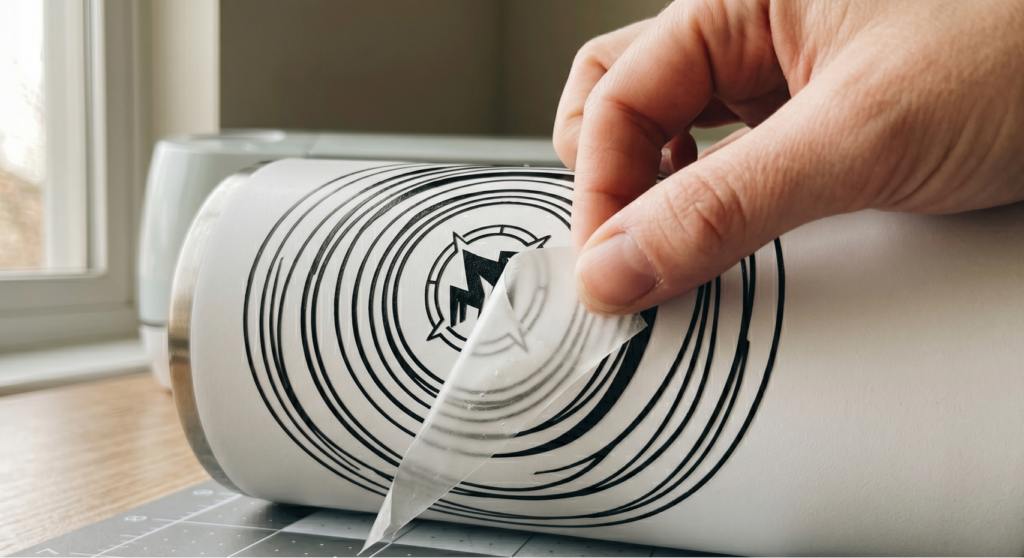
A custom tumbler wrap that takes 45 minutes at $20 an hour is $15 in labor. That number belongs in your cricut pricing formula the same way materials do. If you leave it out, you are working for free. Working for free is not a pricing strategy. It is a way to burn out inside of six months.
3. Packaging and Overhead
Packaging is tissue paper, a shipping box, a branded sticker, or a simple poly mailer. These cost money. Add them.
Overhead is the proportion of your fixed costs that each order absorbs: a share of your Cricut Maker’s purchase price spread across the number of orders it produces, a share of your Cricut Access subscription if you have one, your design software if you pay for it. For most one-person Cricut shops running 15 to 20 hours a week, a $1 to $2 per-order overhead allocation is a reasonable start.
A complete handmade pricing formula includes overhead. Leaving it out means your business costs are coming out of your profit, whether you track it or not.
4. Marketplace or Payment Processing Fees
If you sell on Etsy, you pay a $0.20 listing fee, a 6.5% transaction fee, and a payment processing fee around 3%. On a $30 tumbler, that’s roughly $2.60 to $3 in fees before a single dollar hits your account.
If you use PayPal, Venmo, or Square for direct orders, there are processing fees there too. Percentage-based fees compound as your prices go up. A good cricut pricing formula for Etsy sellers adds approximately 12–15% to the subtotal before materials and labor, or calculates the exact fee structure on each product category.
Ignoring fees is one of the most common errors in cricut pricing for beginners. You price the product correctly and then Etsy takes a piece and you’ve made less than you planned.
5. Desired Profit Margin
Profit margin is not the same as what’s left over after costs. Margin is the deliberate percentage you build into the price above and beyond covering expenses. A 20% margin on a $30 product means $6 stays in the business for growth, slow months, or equipment replacement.
For custom work and lower-volume Cricut products, a 20–30% margin is reasonable. For bulk orders where your per-unit cost comes down, you can hold margin while lowering the per-item price.
This is the component most people skip entirely. Skipping it means you’re pricing to break even, not to build something.
A Step-by-Step Pricing Example: Custom Tumbler Wrap
Here’s how the cricut pricing formula works in practice. One custom 20oz tumbler with a personalized wrap, sold on Etsy.
| Component | Calculation | Cost |
|---|---|---|
| Blank tumbler | $75 / 50-pack | $1.50 |
| Vinyl | $12 roll / 20 wraps | $0.60 |
| Transfer tape | Per project estimate | $0.15 |
| Packaging (mailer + tissue) | Actual unit cost | $1.25 |
| Overhead allocation | Fixed cost share per order | $1.50 |
| Total Cost of Goods | $5.00 | |
| Labor | 45 min at $20/hr | $15.00 |
| Subtotal | $20.00 | |
| Etsy fees (approx. 13%) | $20 x 0.13 | $2.60 |
| Subtotal with Fees | $22.60 | |
| Profit margin (25%) | $22.60 / 0.75 | $30.13 |
| Final Price | Round to nearest dollar | $30.00 |
$30 for a custom personalized tumbler on Etsy is not expensive. It’s priced correctly. If that number feels high to you, ask yourself whether you would work 45 minutes for $7.40. Because that’s what you are doing when you price the same tumbler at $15.
This is the core problem with guessing at how to price Cricut orders. The guess starts from what feels comfortable, not from what the work actually costs.
Ready to Build a Real Cricut Business Around This?
The pricing formula is one piece. The Cricut Cash Business covers what comes next: how to set up your first product line, where to find customers before you have a following, and how to run each week so orders come in consistently. Wendy built this for the seller who’s already making things and wants a clear path to making money.
Turn “you should sell these” into income, without quitting your job
Common Pricing Mistakes and How to Avoid Them
Forgetting to Pay Yourself for Your Time
This is the most expensive mistake in the handmade pricing formula conversation. Time’s a real cost, and it has a real value. If you don’t include labor in your cricut pricing formula, you are subsidizing every order out of your own hours. That’s a fine arrangement for gifts. It is not a business.
Decide on your hourly rate before you price another order. Write it down. Apply it every time.
Underestimating Hidden Costs
Vinyl waste from a failed cut. A second blank because the press scorched the first one. An extra mailer because the first one got damaged. Cricut Access fees spread across the month. These costs are real and they belong in your cricut pricing for beginners math. When you skip them, your margin quietly disappears and you can’t figure out why.
Track actual costs on your first ten orders. The pattern will show you what you’ve been missing.
Copying Competitors’ Prices Without Understanding Their Costs
You found a tumbler on Etsy for $18. You price yours at $17 to be competitive. That seller may be buying blanks at a 200-unit volume discount you don’t have access to. She may have paid off her heat press two years ago. She may be pricing below her own costs and not know it yet.
You do not know her numbers. Her price tells you nothing useful about whether your price is right. The cricut pricing formula exists specifically so you do not have to guess based on what someone else is doing.
Lowering Prices Out of Fear
A customer hesitates. You immediately offer a discount. This is the most common and most damaging pattern in how to price Cricut orders decisions. Most of the time, the customer was not hesitating because the price was too high. She was checking her bank account. She was thinking about colors. She was reading your shop reviews.
Price hesitation is almost never the whole story. Dropping your price at the first sign of pause trains customers to expect discounts and teaches you to doubt math that was probably right to begin with. Hold the price. If you lose the order, you lose it. You don’t lose money on it.
Before You Accept Your Next Order: Do the Math First
Before you confirm another custom request, run the full cricut pricing formula on that specific product.
Write down:
- Every material that goes into it and the unit cost of each
- Exactly how long it will take you, start to finish
- Your hourly labor rate
- Packaging costs for that specific item
- Platform fees if it’s an Etsy order
- Your target margin
Add it up. That is your price.
If the number feels high, sit with it for a moment before changing it. Then ask: would you pay a contractor $7 an hour for skilled custom work? No. So do not charge that for yours.
The handmade pricing formula is not complicated. It takes about ten minutes once you have done it a few times. What it replaces are the anxiety, the guessing, the resentment, the feeling that you are always working for less than you should be is worth considerably more than ten minutes.
Do the math before you take another order.
Conclusion: Pricing Is a Skill. It Gets Better.
The first time you work through a real cricut pricing formula, it will feel slow. You’ll second-guess the labor rate. You’ll wonder if the overhead allocation is right. You;ll hesitate at the final number.
Do it anyway. Write the number down. Charge it.
Cricut pricing for beginners is not about getting it perfect on the first try. It is about replacing a guess with a process. The process improves every time you use it. Within ten orders, the math will feel less foreign. Within twenty, you will stop flinching at the number the formula produces.
Most Cricut sellers who underprice are not unintelligent. They are using the wrong tool. They’re pricing from feelings instead of from a formula. Switching tools is not complicated. It just has to happen before you take the next order.
Your time and skill has a value. The formula is how you make sure both of those things are reflected in every number you quote.
Take the Next Step
Pricing correctly is step one. The Cricut Cash Business walks you through everything after it: setting up for repeat orders, pricing a full product menu, finding local and online buyers, and running a side hustle that actually pays you. One guide, built specifically for Cricut sellers who are done guessing.
Turn “you should sell these” into income, without quitting your job
Frequently Asked Questions
Q1: What is the best cricut pricing formula for beginners?
The most reliable starting point for cricut pricing for beginners is: (Materials x 3) + Labor + Fees. The materials multiplier covers overhead and margin in a single step.
Q2: How do I figure out how to price Cricut orders on Etsy specifically?
On Etsy, you need to account for a $0.20 listing fee, a 6.5% transaction fee, and roughly 3% in payment processing. That’s approximately 10–13% of the sale price in fees, before taxes. Build those fees into your cricut pricing formula before you publish the listing, not after.
Q3: Should I charge for design time in my handmade pricing formula?
Yes. Every minute you spend in Cricut Design Space, adjusting a file, sizing an image, or troubleshooting a cut is labor. It belongs in your handmade pricing formula the same as cutting and pressing time does.
Q4: What hourly rate should I use for Cricut pricing?
The minimum is $15 per hour. For custom or detailed work requiring genuine skill, $20 to $25 is more appropriate. The number you choose needs to be one you can defend when you look at the total order time and the final price.
Q5: How do I handle it when a customer says my Cricut price is too high?
First, do not immediately offer a discount. Ask if they have questions. Often, the hesitation is about something other than price. If they confirm the price is the issue, you have two options: hold the price if your cricut pricing formula produced it correctly, or offer a reduced version of the product (smaller, simpler, fewer customizations) at a lower price point.
Q6: How do I price Cricut bulk orders differently from single items?
Bulk orders reduce your per-unit cost in two ways: materials cost less when bought in larger quantities, and setup time is spread across more units. A correct cricut pricing formula for bulk work recalculates materials at the actual bulk unit price, reduces per-item design time (one design, many cuts), and maintains or improves the margin because the efficiency gain is real.
Q7: Is a handmade pricing formula the same for all Cricut products?
The structure of the handmade pricing formula is the same: Materials + Labor + Overhead + Fees + Profit Margin. The numbers inside it change by product.