Quick Summary: Saturated Resin Jewelry Market
- More sellers doesn’t mean there’s no room left for you.
- A saturated market only shuts you out if your shop looks like every other shop.
- Buyers aren’t choosing between resin and no resin.
- They’re choosing between your shop and the next one in their feed.
- Cloudy resin and technique issues cost you a piece, not a whole shop’s sales.
- If your pours are clean and sales are still slow, check your pricing and positioning first.
- Confident, consistent pricing signals quality, and hesitant pricing reads as cheap.
- A shop with a clear point of view stands out more than a shop with clearer resin.
If you’ve been searching for a reason your shop isn’t moving, you’ve probably landed on the technical stuff first. Cloudy resin. Bubbles. A finish that isn’t quite as clear as the shop three listings down from yours.
That’s a real problem, and it’s worth fixing if it’s what’s actually happening in your mold. We’ve already covered the three most common causes of cloudy resin in detail, so I won’t repeat that here. Go there first if your pieces are coming out milky or frosted.
But here’s what we see over and over with sellers who’ve already fixed their pours and are still stuck. The technique stopped being the problem months ago. The shop still isn’t selling. And the real question underneath that isn’t “what’s wrong with my resin.” It’s closer to this: with this many people making resin jewelry now, why would a stranger pick your shop over the next one in their feed.
That’s a fair question. Let’s answer it directly instead of dancing around it.
The Saturated Resin Jewelry Market Fear Is Real. It’s Also Not the Whole Story.
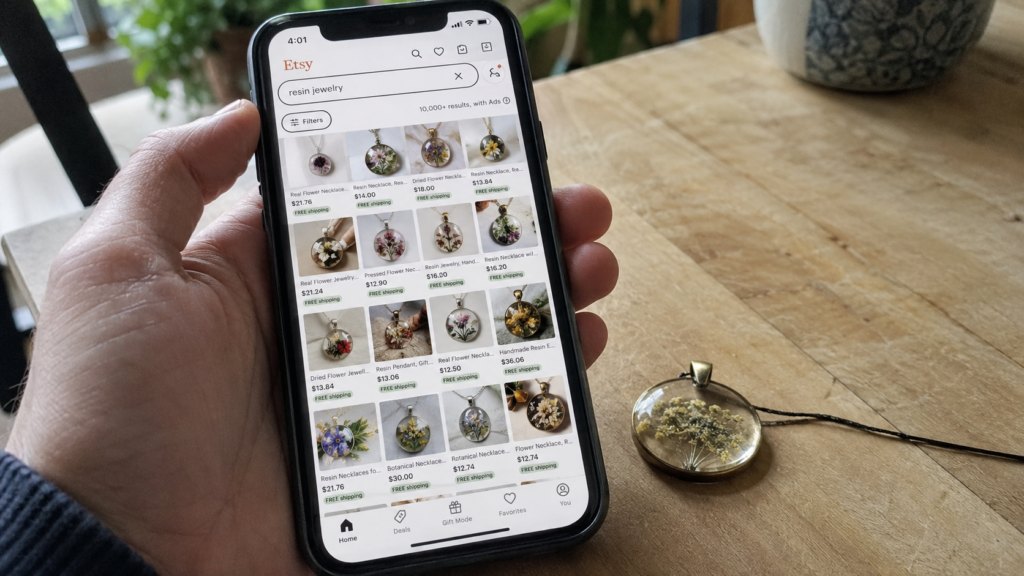
Search “resin jewelry” on Etsy and you’ll get thousands of results back. Scroll TikTok or Instagram for five minutes and you’ll see pour after pour, pendant after pendant, most of it lit the same way. It’s easy to look at that volume and decide the saturated resin jewelry market already closed the door before you got there.
Here’s what that read misses. A crowded market isn’t the same as a market with no room left in it. It means buyers have choices, and they’re making decisions fast, usually on things that have nothing to do with resin technique. Clarity, color palette, and general craftsmanship become table stakes once you’re past your first few dozen pieces. Almost everyone selling resin jewelry today can pour a clean piece by now. That’s not what separates the shops making sales from the ones that aren’t.
What separates them is whether a stranger scrolling past has a reason to stop on your listing instead of the next one. That reason is rarely “the resin is clearer here.” It’s usually something about what the shop stands for, what it costs, and whether the price signals confidence or apology.
I get the instinct to blame the market. It’s a bigger, vaguer target than your own pricing sheet, and it’s easier to feel discouraged by something you didn’t decide yourself. The saturated resin jewelry market isn’t a wall, though. It’s a room with a lot of people standing in it, and some of them are getting picked.
Why Resin Jewelry Isn’t Selling on Etsy Even With Good Technique
If your pours are clean and your shop still isn’t moving, look at two things before you touch your technique again.
Your pricing. A lot of new sellers price like they’re apologizing for existing. A $12 pendant that took real time to design, pour, cure, and finish tells a buyer the maker doesn’t think it’s worth much either. Buyers pick up on that, even if they couldn’t explain why. Underpricing doesn’t win the sale. It trains the buyer to expect a discount shop instead of a considered one.
Run the actual math before you decide your price is fine. Resin, findings, packaging, and your own time all cost something, and most sellers have never added it up. A pendant that costs you six dollars to make, once you count everything, isn’t priced right at twelve. It’s priced at a loss once you factor in your hours.
Your positioning. “I sell resin jewelry” isn’t a reason to buy from you specifically. Thousands of shops can say the same sentence. “I sell resin jewelry made with pressed flowers from your own garden” is a reason, because it tells the buyer exactly what they’re getting and why it’s personal to them. The technique behind that is its own topic, covered elsewhere. [Link: homemade-resin-jewelry-from-pressed-flowers] The point here isn’t the flowers. It’s that a specific promise beats a general one every time.
The saturated resin jewelry market punishes shops with no clear identity and rewards shops that know exactly who they’re making for. Neither pricing nor positioning is a resin problem. Both are decisions you can make this week, without touching your mold or your lamp.
What a Buyer Actually Compares Before They Click Buy
Picture someone scrolling Etsy for a resin pendant as a gift. She has a dozen tabs open, whether she’d admit it or not. She is not evaluating your cure time or your bubble count. She reads four things fast: the photo, the price, the first line of your listing, and whether the shop feels like it knows what it’s doing.
The photo tells her if this looks like a considered product or a hobby experiment. Price signals whether you believe in what you made. That first line shows her if you understand what she’s actually shopping for, whether it’s a gift, a memorial piece, or something for herself. And the rest of the shop, the other listings, the about section, the reviews, tells her if you’ll still be around next month if something goes wrong with the order.
Resin clarity isn’t part of that list, which means every item on it is something you can decide before you pour another piece.
How to Stand Out Selling Resin Jewelry Without More Tutorials
The instinct when sales are slow is to go learn another technique. A new pour style, a new embed, a new finish. Sometimes that helps. Most of the time it adds a new skill to a shop that still doesn’t know what it charges or who it’s for.
Standing out starts with pricing that holds. Aim for a price that reflects your actual cost and your actual time, with margin built in so you can keep doing this past the first few months. When you know your numbers cold, it shows up in how you write your listing and how you answer a message asking for a discount. Confidence reads as quality, even to a buyer who’s never met you.
It also means picking a lane. You don’t need to be the shop that does everything. You need to be the shop that’s the clear answer to one specific thing a specific buyer wants. That might be pressed flower pendants for garden lovers, birth flower jewelry for new moms, or pet memorial pieces. Pick one you can say in a sentence, and let it show up in your photos, your listing titles, and your pricing.
Where to Start
Start with your numbers. Most sellers have never actually run the math on what a piece costs them to make, down to the resin, the findings, the packaging, and their own time. Once you know that number, pricing gets a lot less emotional and a lot easier to defend.
We built a free calculator that walks you through exactly that. It’s a quick way to see what your pieces actually need to cost before you touch your listings again. [Link: Resin Profit Calculator opt-in]
Conclusion
A saturated resin jewelry market is real, and it isn’t going anywhere. That doesn’t mean your shop is out of room. Clean technique gets you in the door. Pricing that holds and a shop that knows what it stands for are what get you picked once you’re through it. If your pours are already solid and sales still aren’t coming, that’s where to look next.
FAQ
Is the resin jewelry market too saturated to start now?
No. It’s more competitive than it was a few years ago, but new sellers still break in every month. The ones who struggle usually have unclear pricing or no defined niche, not bad timing.
Why isn’t my resin jewelry selling on Etsy even though my pieces look good?
Good technique gets your listings in front of buyers. It doesn’t close the sale on its own. Check your pricing and your positioning before you assume it’s a craftsmanship issue.
Should I lower my prices to compete in a saturated resin jewelry market?
Usually not. Underpricing tends to signal low quality rather than good value, and it makes it harder to raise prices later. Confident, cost-based pricing is usually the stronger move.
How do I stand out selling resin jewelry when so many people are doing it?
Pick a specific angle you make for a specific buyer, and price it like you believe in it. A clear identity does more for differentiation than a new pour technique.
Does having more listings help me stand out in a saturated market?
Not by itself. A shop with fifty unfocused listings can be harder to remember than a shop with ten that all point at the same idea. Volume without a clear identity just adds more noise to your own shop.
What should I fix first if I think my technique is fine but sales are still slow?
Start with your pricing. Run the actual cost of a piece, including your time, and compare that to what you’re charging. If the number doesn’t hold up, that’s usually the first thing to fix before anything else.