
At a Glance: Is the Junk Journal Market Saturated or Not?
- The junk journal market isn’t saturated. Buyer demand is active and consistent.
- It’s just that most Etsy junk journal shops are under-optimized, not under-priced.
- Comparison pricing is the most common mistake sellers make, and it looks like a market problem from the outside.
- A shop with 300 sales at $38 outearns a shop with 900 sales at $14.
- The fix starts with one calculation most sellers skip: your actual cost per journal.
- Download the free pricing sheet to run the numbers before you list.
Is the Junk Journal Market Saturated?
You opened Etsy. You scrolled the junk journal category for twenty minutes. You saw shops with 2,000 sales, reviews going back to 2017, and listings priced at $14 for something that took someone four hours to make. You closed the tab.
That is not research. That is a fear spiral with a search bar.
The question is worth taking seriously, though, because the answer affects what you do next. So here it is, broken down honestly.
The Short Answer is…
No. The junk journal market is not saturated. Buyer demand for handmade junk journals is active and has held steady across major search platforms for the past three years. The problem most sellers are running into is not that there are too many journals for sale. It is that most of the journals for sale are priced wrong, described poorly, and listed by sellers who learned how to make the product but never learned how to sell it.
That is a different problem. And it is one you can solve.
What Does “Saturated” Actually Mean?
Saturation has a specific definition. It means buyer demand has flattened or declined, and the number of sellers has grown beyond what that demand can support. When a market is truly saturated, prices fall across the board, margins disappear, and even established sellers start losing ground.
That is not what is happening in the junk journal space.
What is happening is that a large number of sellers entered the market without a pricing strategy, set their prices by looking at competitors, and quietly built shops that cannot sustain themselves. From the outside, that looks like crowding. From the inside, it is a pricing problem wearing a market problem’s clothes.
Crowded and saturated are not the same thing. A crowded market with weak competition is an opportunity.
Is There Still Demand for Junk Journals?
Yes, and it is specific.
Search interest in junk journaling has remained consistent over the last three years. Sub-categories including vintage ephemera journals, nature-themed journals, and travel journals have grown. Buyers are not hard to find. They are on Etsy, on Pinterest, and at weekend markets actively looking for handmade paper goods they cannot find at a craft store.
The demand side of this market is not the problem.
What has grown alongside buyer demand is the number of sellers who entered at the same time, learned technique from YouTube, and set up Etsy shops without touching the business side. The result is a category full of skilled makers charging prices that do not add up. That creates the appearance of a flooded market. It is actually a market full of underpriced product and under-optimized shops, which means there is genuine room for a seller who gets the business basics right.
Why Do So Many Junk Journal Shops Look the Same?
Because they all started from the same place.
Most junk journal sellers found the craft on Pinterest or YouTube, learned technique from tutorials, got genuinely skilled, and then set up an Etsy shop by doing one thing: opening the category, finding the cheapest listing, and pricing just below it to be competitive.
That move feels logical. It is the single most damaging thing a new seller can do.
When you price below the cheapest competitor, you are not positioning yourself as a value option. You are telling every buyer who finds your listing that your work is worth less than the person who was already charging the least. You have not entered the market. You have joined a race to the bottom that nobody wins.
The shops that look oversaturated are mostly running this same play. Similar price points, similar photography, similar listing descriptions that say “handmade junk journal, mixed media, 80 pages” and nothing else. None of that is a market problem. It is a business skills problem, and it is widespread enough that a seller who does the basics differently will stand out immediately.
One listing with clean photography, a specific description written for a specific buyer, and a price that accounts for actual time and materials will outperform ten listings that were built by scrolling competitors.
RELATED: How to Photograph Junk Journal Products at Home Using Only Natural Light
Can You Still Make Money Selling Junk Journals on Etsy?
Yes. With realistic expectations and the right setup.
Here is what the numbers actually look like for sellers who have figured out the business side:
A shop clearing $1,100 a month from physical journal sales alone is not unusual for a seller who has been at it for 12 to 18 months, has consistent photography, uses Etsy SEO intentionally, and prices at or above market midpoint rather than below it.
Add a second revenue stream, printable ephemera packs priced between $4.50 and $9, and that same seller can add several hundred dollars a month in sales that require no additional production time.
Two local craft shows a year, priced and displayed correctly, can add $1,000 or more per show.
None of those numbers require a large following, paid advertising, or a team. They require getting the business fundamentals right before scaling anything.
The sellers who say the market is dead are usually the ones who priced at $15, made twelve sales, and burned out. That is not a market problem. That is a setup problem.
How Do You Know If It Is a Pricing Problem, and Not a Saturation Problem?
Run through these four questions honestly.
1. Did you set your price by looking at what competitors charge? If yes, you do not have a price. You have a guess borrowed from someone else’s guess, and that person probably made the same mistake before you.
2. Have you ever lowered your price when sales slowed down? Discounting during slow periods is the most common reflex in handmade selling. It almost never solves the actual problem, which is usually search visibility or seasonality. What it does is train future buyers to wait for a discount and signals to the algorithm that your regular price is inflated.
3. Do you feel a small amount of resentment after a sale goes through? If your first thought when a journal sells is “I spent six hours on that,” your price is wrong. Not the market.
4. Have you ever calculated your actual cost per journal? Time, materials, Etsy fees, shipping supplies, and packaging all have a number. Most sellers have never added those numbers up. If you have not done that calculation, you are not running a shop. You are running a hope.
If you answered yes to two or more of those, the market did not close on you. Your pricing strategy needs to be rebuilt from the floor up.
The truth about pricing junk journals is calculating your actual costs is just the first step. Once you know your baseline, you still have to build listings that buyers can find and trust enough to pay your full price. When you quote below the cheapest competitor, you tell every buyer your work is worth less. I did exactly that for eight months. And that mistake cost me around $3,000 in total.
I wrote this book because I kept meeting makers who were much better at this craft than I am, but they were charging next to nothing for their work. It’s frustrating to watch talented people leave money in a pile on the floor just because they do not know the business side of things. So I wrote down the actual business stuff so you can stop wasting time and materials learning the hard way.
This guide covers the pricing strategy, the listing details, and the exact way to add passive digital products to your shop. It is the manual you need to turn your own craft space into a reliable income.
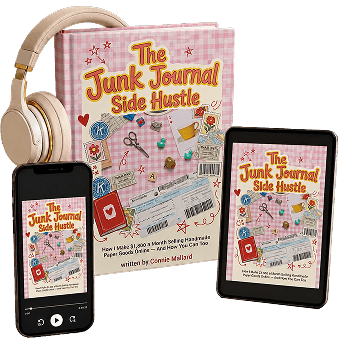
A simple, step-by-step business guide for the woman who already knows the craft and is ready to stop giving their work away.
Frequently Asked Questions
Is junk journaling still popular? Yes. Search interest in junk journaling has held steady for three years and grown in several sub-categories including vintage and nature-themed journals. The buyer base is active on Etsy, Pinterest, and at in-person markets.
Is the junk journal market saturated? No. The market is crowded with under-optimized shops, but buyer demand remains strong. Most sellers are pricing by comparison and leaving significant money on the table, which creates room for sellers who approach the business side with more intention.
How much do junk journals sell for on Etsy? Most Etsy junk journal listings fall between $12 and $48. Sellers who price in the $28 to $42 range with strong photography and specific listing descriptions tend to earn more per hour of production than sellers clustered at the low end, even when they sell fewer units.
Is it too late to start selling junk journals? No. New shops break into established Etsy categories regularly by doing the business basics better than existing sellers. Photography, pricing, and listing copy are the three most common gaps, and all three are learnable.
Why aren’t my junk journals selling? The most common reasons are search visibility, pricing position, and listing descriptions. A listing that says “handmade junk journal, mixed media” gives a buyer no reason to choose it over the next listing. Describing who the journal is for, what makes it specific, and why someone would want it as a gift or for themselves converts significantly better.
How do I price a junk journal? Start with your actual costs: materials, time at a realistic hourly rate, Etsy fees, and packaging. That total is your floor. From there, research where the mid-to-premium range sits in your specific sub-category, not the cheapest listings in the broader category. The free pricing sheet linked above walks through this calculation.