
A junk journal is a handmade book built from salvaged materials: vintage book pages, old ephemera, repurposed paper goods, cereal box covers, ledger sheets, and anything else that has texture and history to it. Makers layer and bind these materials into journals that sell on Etsy, at local craft markets, and as digital downloads. Some makers do this part-time at 12 to 15 hours a week and bring in $1,800 a month. Some do considerably less because they have the skill but not sure how to price them profitably.
If you already know how to make a junk journal and you have been giving most of them away or selling them for whatever felt safe to ask, this is the guide you’re looking for. It is not a tutorial on the craft but a playbook on figuring out what your junk journal listing is actually worth using a structure that works at every level of buyer.
Why Most Junk Journal Sellers Get the Price Wrong

Most sellers underprice because they use the wrong method.
Here is what usually happens. You open Etsy, search “junk journal,” find a listing that looks roughly like yours, you see it’s priced at $18.99, and decide to list yours at $16 to be competitive. That feels like a logical move. Well, it’s not, because you just priced your work below a listing that may have been underpriced to begin with.
I did this for eight months when I first opened my shop. Whenever sales slowed, I discounted. Whenever I saw a cheaper listing, I adjusted. I was not building a pricing strategy. I was in a slow race to the bottom with sellers I had never met, over buyers I was not going to attract anyway.
Scrolling through Etsy to get the real value is a trap. And the longer you stay in it, the more money it costs you.
What Your Price Tells a Buyer Before They Click
Before a buyer reads your listing description, before she looks at your photos, they see your price. That number tells her something.
A $16 journal tells them the materials were probably inexpensive, the maker is not confident in the craft, or the market has decided it’s not worth more. Meanwhile, a $65 journal tells her the maker has priced it like someone who knows what the work is worth. Neither of those signals is about the actual quality of the journal, but about what the price communicates to the customer.
In reality, the buyer who’s willing to spend $65 on a handmade journal is not browsing for $16 listings or the cheapest options. They’re looking for the right one. If you price your work at $16, you’ll become invisible to them.
Going lower doesn’t always pull in more buyers. It pulls in different buyers, and not the ones who’ll come back.
Three Pricing Mistakes That Keep Sellers Stuck
Before we get into the actual numbers, it helps to know what not to do. These three mistakes show up constantly, and they are all fixable once you can see them.
Pricing by comparison. This is the Etsy scroll problem described above. You set your price based on what someone else is charging, without knowing their material costs, their production time, or whether they are making any money at all. Someone else’s underpriced listing is not a benchmark. It is a warning.
Treating your time as free. A lot of sellers calculate material cost, set a price that covers it, and call it a day. They leave their labor out of the math entirely because it feels awkward to charge for time spent on something they enjoy. If your time has no value in your pricing, your business has no floor. You can work more and earn exactly the same amount, or less, if costs go up.
Discounting when sales slow instead of fixing the listing. This one cost me the most. When Etsy traffic dropped, my instinct was to lower the price to get things moving again. What I should have done was look at my listing title, my photos, and my tags, because those were the actual problem. Discounting a listing that buyers cannot find does nothing except lower your margin on the sales you eventually make.
How to Actually Price Handmade Junk Journals: The Four-Tier Method
One product at one price is the most common setup in small handmade shops, and it is the setup that limits income the most. If you only sell full-size journals at $45 each, you have one kind of buyer and one kind of transaction. The buyer who would have spent $9 on an ephemera pack to try out your shop, liked what she got, and come back two months later for a $65 journal, never gets that entry point. She either buys the full journal immediately, which many buyers are not ready to do with a shop they do not know yet, or she moves on.
Four products at four price points give every interested buyer a place to start and a reason to come back. Here is what that looks like.
Tier 1: Loose Ephemera Packs ($8 to $15)
A loose ephemera pack is a curated bundle of vintage paper materials: book pages, die-cut tags, washi tape samples, kraft scraps, printed cards. You are selling supplies that another journaler will use in her own projects. The pack takes about 15 to 20 minutes to assemble. It ships in a small bubble mailer. Your material cost on a well-sourced pack runs between $1.50 and $3.
The margin on this tier is around 70 to 80 percent. More importantly, it is your lowest barrier to entry. A buyer who is curious about your shop but not ready to spend $65 can test your curation and taste for $9. If she likes what she gets, she comes back. That is the whole point of this tier.
Tier 2: Mini Journals ($20 to $35)
A mini journal is a small-format finished journal, typically A6 size or smaller, with a decorated cover and 30 to 50 pages inside. It takes 45 to 60 minutes to make and runs about $3 to $6 in materials. Mini journals are good impulse buys at craft fairs. They are also useful for testing design directions before you build a full journal in the same aesthetic. If a particular vintage floral style sells well as a mini, you have early evidence that a full journal in that style will find buyers too.
Tier 3: Full Journals ($45 to $90)
This is your core product. A full journal at this tier has a substantial cover, 80 to 120 pages of mixed paper types, intentional design throughout, and a binding that opens flat. Production time runs 2 to 3 hours. Material cost is between $6 and $14 per journal depending on what you sourced and what you bought new.
This is also the most underpriced tier for most sellers. The instinct is to stay under $50 because it feels like a lot to ask. But the buyer who is looking for a $65 handmade journal is not deterred by the price. She is relieved to find one worth it.
Tier 4: Snail-Mail Kits ($60 to $120)
A snail-mail kit is a pre-assembled collection designed for someone who wants to send handmade letters: decorated envelopes, stationery pages, wax seal materials, twine, tags, and a few vintage ephemera elements. Production time is 1 to 2 hours. Material cost runs between $8 and $18 per kit.
The distinction that matters here is that these are pre-made, not commissioned. You build ten of them in an afternoon, photograph them, list them, and sell them at whatever pace they sell. Commissions take more time to scope and are harder to price consistently. Pre-made kits are not either of those things.
What Happens When You Price All Four Correctly
Here is what a real buyer progression looks like across this structure.
She finds your Etsy shop through a search for ephemera supplies. She spends $9 on a loose pack. It arrives looking exactly like your photos. She uses it in a journal she is working on and checks your shop again. Two weeks later she picks up a mini journal at $28 as a gift for a coworker. Six weeks after that, she orders a full journal for her sister’s birthday at $65. Two months later she comes back for a snail-mail kit at $75 because she has been wanting one for herself.
That is $177 from one buyer over about three months. No advertising. No social media. No discount codes. She moved through the tiers because each product gave her a reason to trust you a little more before spending a little more. A shop with one product at one price loses every single one of those transactions except the first one, if it gets that far.
The Math You Need Before You Set Any Price
None of the numbers above mean much if you do not know what your materials actually cost per journal. That is the foundation everything else builds on.
Keep a simple sourcing log. Write down what you bought, what you paid, and how many projects it will yield. A $2 bag of estate sale paper that covers eight journals costs you 25 cents per journal in materials. A $1.50 library sale hardcover that gives you pages for three journal interiors costs 50 cents per journal. Add those numbers up across everything you used to build one product, and you have your material cost.
Once you know that number, you can set a price that covers your costs, accounts for your time, and still lands where buyers in each tier expect to pay.
The free pricing sheet below does the math for you. Put in your material costs and your production time, and it gives you a working price for each tier.
One More Thing Before You Go
You already know how to make the product. The craft was never the problem. Pricing it correctly is a learnable skill, and the four-tier structure gives you a starting point that is grounded in what buyers at each level actually pay.
Start with your material cost. Set your tier prices from there. List the products. Then leave the prices alone and see what happens.
For the complete system, including Etsy SEO, listing photography, repeat buyers, and how to add a digital income layer to your shop, The Junk Journal Side Hustle by Connie Mallard walks through all of it. It is the business side of a junk journal shop from pricing through your first $1,800 month.
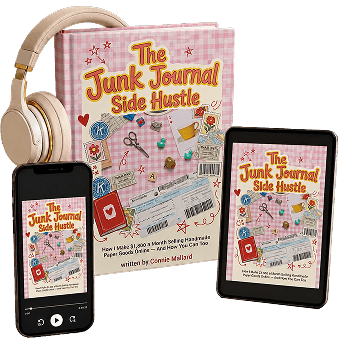
A simple, step-by-step business guide for the woman who already knows the craft and is ready to stop giving their work away.
Frequently Asked Questions
What is a fair price for a handmade junk journal? A well-made full-size junk journal should generally be priced between $45 and $90 on Etsy. Pricing below $35 for a full journal usually means the maker is not accounting for their time or is pricing by comparison. Buyers who are shopping for quality are not deterred by a $65 price. They are looking for a reason to trust it.
How do I know if I am undercharging for my junk journals? A few signals: your journals sell quickly every time you list them, buyers rarely negotiate or ask for discounts, and you find yourself making a lot of journals without feeling like the income reflects the time you put in. If all three of those are true, your prices are probably too low. Raise them on your next listing and see what happens.
Should I price my junk journals the same on Etsy and at craft fairs? Yes. Keep your prices consistent across channels. Buyers talk to each other, and inconsistent pricing creates confusion and erodes trust. The only exception is a craft fair exclusive or a limited item you are not listing online.
Is the junk journal market too saturated to make real money? Most junk journal listings on Etsy are poorly listed, not well-priced, or both. A listing with good photos, a title that matches how buyers actually search, and a price that signals quality will consistently outperform a listing with two years of shop history behind it. The market is not full. It is badly listed.
How long does it take to build a junk journal income to $1,800 a month? Realistically, four months with consistent work. That means active Etsy listings, at least one digital product, and ideally one local market under your belt. Some sellers get there faster. Some take six months. The ones who skip the pricing and photography work take the longest.