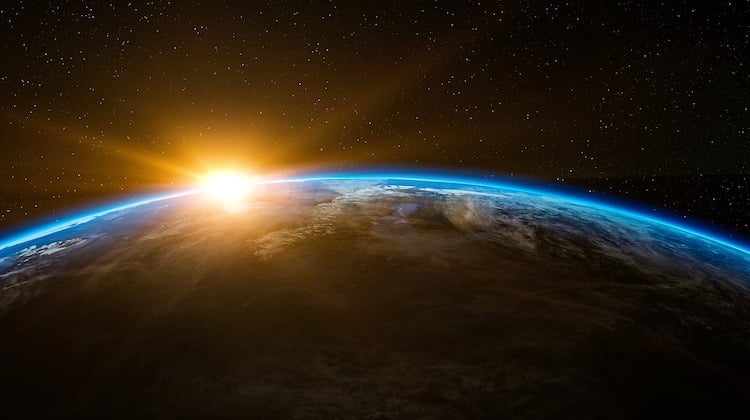

It should be a given that the Earth is round, right? Should be is right. But believe it or not, there are some lingering roundness doubters out there, including T.V. personality Tila Tequila and rapper B.o.B.
7 DIY Experiments You Can Do to Prove Earth is Round
B.o.B, known for hit songs like “Airplanes” and “Nothin’ on You,” tweeted up a storm earlier this week, claiming the Earth was indeed flat and NASA is complicit in the conspiracy to keep this info under wraps. Ummmmmm.
Noted astrophysicist Neil deGrasse Tyson eventually jumped in to explain why the Earth is most certainly round.
“Flat Earth is a problem only when people in charge think that way,” Tyson tweeted to the rapper.” No law stops you from regressively basking in it.”
Eventually the argument developed into a full-on rap battle!
Which brings me to my point: If you’re not one to trust the word of others (even if it’s established scientific fact), put on your experimenter hat and find out for yourself.
PBS put together a list of 7 DIY experiments you and rapper B.o.B can do to prove the Earth is round. Don’t make up your mind about our planet’s shape until you try them:
Experiment 1: Watch a lunar eclipse
Things you’ll need: functioning eyes, the moon, and a telescope (optional).
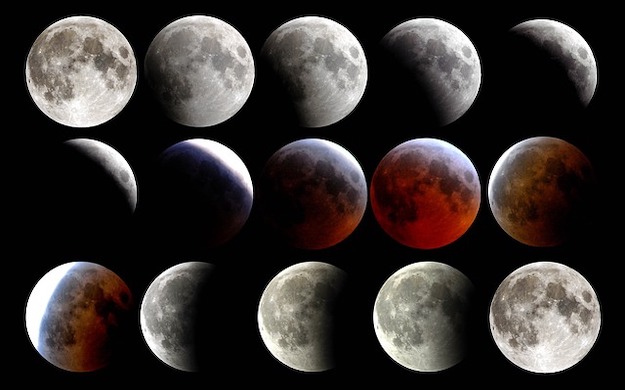
Every now and again, the Earth passes between the moon and the sun, completely blocking its light and casting a shadow across the moon called a lunar eclipse. If you look closely while this happens, you would notice that the Earth’s shadow forms an arc as it creeps across our view of the moon.
You might respond, “You’ve shown the Earth is round, but couldn’t it be round, but still flat — a flat disc?” Well, your eyes and telescope would also spot the 3D spherical nature of the moon. The Flat Earth Society does admit that the moon, the sun and other planets are indeed spherical, but claim that the “Earth is not a planet,” and unlike other celestial bodies, is flat.
So let’s ignore the moon for now and examine the other member of the eclipse trifecta: the sun.
Experiment 2: Take a trip to San Francisco and Seattle
Things you’ll need: A flight ticket, a long straight stick and a tape measure.

As theoretical physicist Ethan Siegel explains in great detail, you, me and B.o.B have something in common: we can use the sun to witness the curvature of the Earth. Here is Siegel:
…the Sun reaches a much higher point (and shines for more hours during the day) during the summer months, and reaches a significantly lower point (and shines for fewer hours) during the winter…
In fact, if you charted out the Sun’s path through the daytime sky, you would find that it takes its lowest path (for the fewest number of hours) on the Winter Solstice — usually December 21st — and its highest path (for the greatest number of hours) on the Summer Solstice, usually June 21st.
If you constructed a camera capable of photographing the Sun’s path through the sky over the course of the year, you would find exactly this: a series of arcs, where the highest, longest arc through the sky was made during the Summer Solstice and the lowest, shortest arc was made during the Winter Solstice.
On a midsummer’s day more than two millennia ago, Ancient Greek astronomer Eratosthenes of Cyrene noticed this too.
While a scholar at the library of Alexandria, Eratosthenes heard of a deep well in the southward city of Syene (now Aswan, Egypt). Once a year on the summer solstice, the citizens of Syene noticed that sunlight reflected off the well’s bottom. They also saw that sticks and tall buildings cast no shadows, suggesting the sun was directly overhead. But in Alexandria, on the same day, Eratosthenes found that sticks did cast a shadow. By measuring the angles of those shadows and by hiring surveyors to measure the distance between Syene and Alexandria, he not only was able to calculate the curvature between the two cities but also the circumference of the entire Earth.
Luckily, B.o.B doesn’t need to travel to Egypt to replicate this test, he need only visit our West Coast.
One of the keys to Eratosthenes discovery came from Syene being due south of Alexandria. Stated otherwise, they lie on the same meridian.
Luckily, the same applies to San Francisco and Seattle. If B.o.B were to ever perform in the two cities on back-to-back days, he could replicate the work of Eratosthenes himself. If he heads to a park on both days, he could jab a meter stick in the ground, measure the angle that the shadow makes with the ground at high noon and reproduce Eratosthenes’ calculation.
This experiment would work in any two cities on the same meridian, provided they’re 200 miles away from each other.
Experiment 3. Watch the sunset lying down
Things you’ll need: The ground and the horizon.
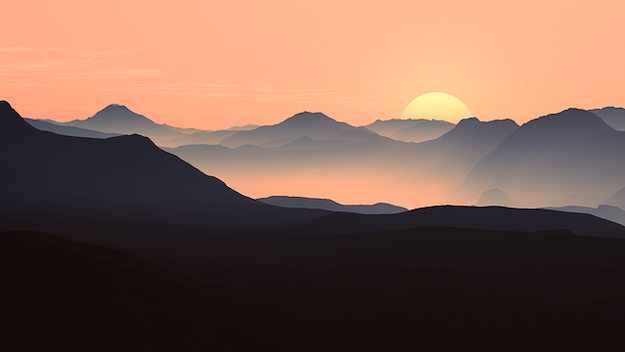
Perhaps B.o.B and his entourage don’t have the air miles for a trip between San Francisco and Seattle. No problem. All they need is a beach on the Pacific Coast (or an unobstructed view of the horizon).
As detailed by the folks at MinutePhysics, the horizon is one of the easiest ways to validate the Earth’s curvature. As the sun dips behind the horizon, it slips from your view in a bottom-up direction. If you watch the sunset while lying on your back, and then hop up as the last rays disappear, then you should be able to see the sunset again.
The same pattern applies to ships as they sail away — their hulls disappear from the bottom up. As MinutePhysics points out, if the Earth didn’t curve and the horizon didn’t exist, when you looked at Chicago from across Lake Michigan, you’d be able to see the the Rocky Mountains.
Experiment 4: Shadow games and time zones
Things you’ll need: a 3D globe or soccer ball, a 2D world map and a bright lamp.

It’s always daytime somewhere and nighttime somewhere else. Five centuries of calculations argue that’s because the Earth is a spinning globe upon which the sun’s rays strike from a single direction.
You can test this idea with a lamp, a soccer ball and a dark room. Put the lamp and ball next to each other on a table. Now, turn off all the lights, and then switch on the lamp. Half of the ball should be illuminated, while the other half remains dark. If you want a facsimile of how this works for us, then replace the soccer ball with a globe.
The Flat Earth Society offers an alternative: The sun is a sphere with a diameter of 32 miles that is located approximately 3,000 miles above the surface of the Earth. They argue that the sun moves like a crib’s mobile, circling above our flat planetary disc.
The problem with this spotlight hypothesis is the sun doesn’t behave like a spotlight. Imagine you’re at a Broadway show, and you see a spotlight shining on a lead actor. You can see the light beams hitting their face, yet you’re sitting in darkness. But on Earth, you can’t stand in an open area and then look off in the distance and see the neighboring land basked in light.
See the remaining three DIY experiments on PBS here!
Love these DIY experiments? You’ll also love…
How to Bake Cookies Using the Scientific Method
Stay connected with us on Facebook, Twitter, Pinterest and Instagram!