
At A Glance: Cloudy Resin Jewelry Fix
Cloudy resin jewelry happens for three reasons: moisture in the mold or on the embed, using epoxy resin under a UV lamp, or inconsistent measuring. Moisture leaves a frosted finish throughout the piece. Epoxy under a UV lamp won’t cure properly regardless of how long you leave it. Inconsistent measuring creates uneven cure depth, which shows up as patchy cloudiness on the surface.
Identify which one matches your failed pour, then follow the fix for that cause only.
Your resin came out cloudy because of a specific, fixable cause. Not because of you.
If you’re looking for a cloudy resin jewelry fix, you’re probably staring at a piece that looked promising in the mold and came out milky, frosted, or hazy on the other side. It happens to most beginners at least once, and it almost always traces back to one of three variables. Before you spend another dollar on supplies, find out which variable caused your cloudy resin result. The fix is usually free or close to it.
Here are the three causes:
- Moisture in the mold or on your embed
- Using epoxy resin under a UV lamp
- Inaccurate measuring
Match what you see to the list. Then read the section that applies.
Cause 1: Moisture in the Mold or on the Embed
This is the most common cause of cloudy resin jewelry, and it’s the one that catches beginners first.
Silicone holds humidity. If you poured into a mold that wasn’t fully dry, or if you placed a botanical embed that still had surface moisture on it, the resin reacts to that water during cure. The result is a milky or frosted finish that goes all the way through the piece. It doesn’t look like a bubble. It looks like the resin itself went bad.
It didn’t. The mold was wet.
A lot of people searching for a cloudy resin jewelry fix after working with botanicals assume the problem is chemical, like something in the resin failed. It’s almost never that. Resin doesn’t cloud without a cause, and moisture is the most common one by a wide margin. If your finished piece has a consistent frosted look throughout, especially near where the embed sits, moisture is where you start.
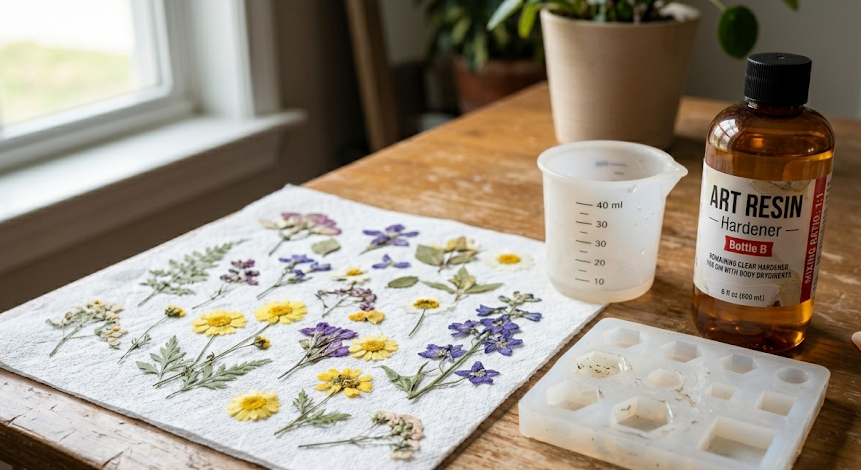
The fix: Wipe the mold cavity with a clean, dry cloth before every pour. Let it air out for 30 minutes, or run a heat gun across the opening for two seconds at six inches. For botanical embeds, pressed flowers and dried leaves need to be completely dry before they go into the mold. If you dried them yourself, give them an extra day. If you bought them pre-dried, spread them on a paper towel for an hour before use. Any surface moisture on the embed will produce the same cloudy resin result as a wet mold.
This fix costs nothing and takes less than five minutes. Do it before every pour.
One more thing on botanicals: thicker plant material holds more moisture than thin petals. If you’re working with anything that has a stem or a bulky center, press it longer than you think you need to. Two weeks under weight is more reliable than three days, and it removes moisture as a variable entirely.
Cause 2: Using Epoxy Resin Under a UV Lamp
This is the cause most people don’t see coming, and it produces more cloudy resin jewelry than any other single mistake among first-time buyers.
Here’s what happened: you bought a kit labeled “craft resin.” You put it under your UV lamp. It didn’t cure. Or it cured on the surface and stayed soft underneath. Or it came out milky and tacky and wouldn’t harden no matter how long you left it under the light.
That’s because it was epoxy, not UV resin. A UV lamp does nothing to cure epoxy. Epoxy cures through a chemical reaction between two components. UV resin cures through light exposure. They’re different products with different cure mechanisms, and the craft industry labels them the same way.
The labeling problem is real. “Craft resin” is a marketing category, not a chemistry category. It includes both epoxy and UV resin, and the packaging doesn’t always make it obvious which one you bought. This is why so many people end up with a resin pour that came out milky after doing everything the instructions said.
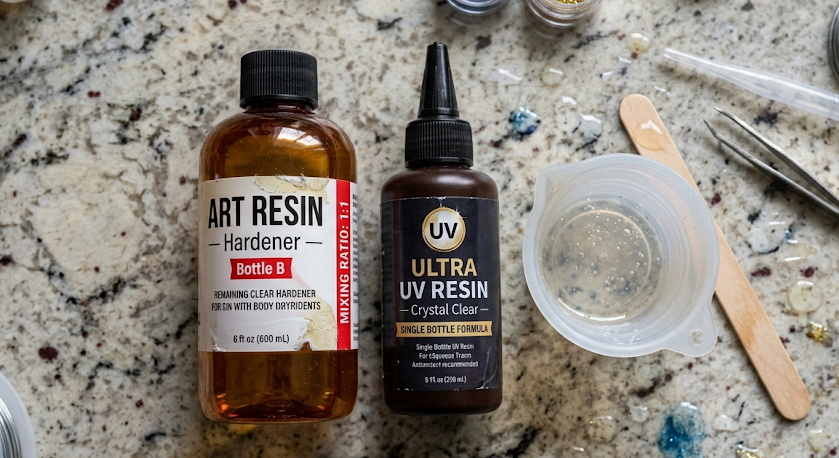
Here’s how to tell them apart before your next pour. Open the box. If there are two bottles, or if there’s a mixing ratio printed anywhere on the bottle or the box, it’s epoxy. A 1:1 or 2:1 mixing ratio means two-part epoxy. A UV lamp will not cure it. If there’s a single bottle with no mixing instructions, look up the product name online to confirm it’s UV-cure resin.
This is the highest-recognition moment for most people researching a cloudy resin jewelry fix. They bought a two-part kit, assumed all resin works the same way, and ran it under a lamp. The pour failed not because they did anything wrong with the pour itself, but because they had the wrong product for their equipment.
If that’s your situation, you don’t need a technique adjustment. You need to order UV resin. The pour process stays largely the same. The product changes.
It’s also worth knowing that epoxy and UV resin produce different finishes even when used correctly. Epoxy tends to self-level over a longer cure window, which works well for larger pours and deep molds. UV resin cures fast, stays where you put it, and is better suited for small jewelry molds where precision matters more than volume. Neither one is wrong. They serve different applications, and knowing which one you have determines everything about how you use it.
For a full breakdown of how UV resin and epoxy resin differ in cure time, finish, and jewelry application, see the UV resin vs. epoxy resin comparison article.
Already Know Your Cause?
The Bundle Covers the Fix and What Comes After.
Diagnosing a cloudy resin pour is step one. The harder question is what to make once your results are consistent, which six products actually sell, and how to price them without guessing. That’s what Clear Results covers in full.
If you’re done troubleshooting and ready to build something that earns, grab the bundle below.
Cause 3: Inaccurate Measuring
UV resin is a single-component product, so you might assume measuring doesn’t matter. It does, but not in the same way it does with epoxy.
The issue is viscosity. UV resin gets thinner when it’s warm and thicker when it’s cold. If you’re pouring directly from the bottle into the mold, the amount you’re dispensing changes based on room temperature, how long the bottle has been sitting, and how high you’re holding it above the mold. That inconsistency affects how the resin distributes across the mold cavity, which affects how evenly the UV light penetrates during cure. Uneven cure depth is a reliable producer of cloudy resin jewelry, particularly in the thicker sections of the mold.
This cause shows up more often in winter. Cold rooms thicken the resin, which makes it pour slower and pool unevenly. If your cloudy resin problem started in a colder month and you didn’t change anything else about your process, temperature-related viscosity is likely part of the cause.
The fix: Use a graduated silicone cup. Dispense the resin into the cup first, check the amount, then pour into the mold. This adds thirty seconds to your prep and removes one variable from your process. It also makes it easier to add pigment consistently if you’re working with color.
If you’re working in a cold room, warm the resin bottle in a bowl of warm water for two to three minutes before dispensing. Don’t use hot water. You want the resin at room temperature, not heated. This brings the viscosity back to a predictable baseline and makes the pour easier to control.
The Label Problem Nobody Warns You About
The most common single mistake behind a cloudy resin jewelry result is trusting the label “craft resin” without confirming the cure method.
Do this instead. Pick up the bottle or open the box. If there are mixing ratio instructions anywhere, it’s epoxy. Set it aside for a project that doesn’t require a UV lamp. If it’s a single bottle with no mixing ratio, look up the product name and confirm it cures under UV light before you pour.
This takes two minutes. It eliminates the most frustrating source of a milky resin pour, which is spending an hour on a piece that was never going to cure the way you expected.
Starter kits sold through general craft retailers often include two-part epoxy without making the cure method prominent on the front of the packaging. The word “resin” appears in large print. The mixing instructions appear in smaller print on the side or back. If you’re buying based on a search result and you don’t know the difference yet, it’s an easy mistake to make. It’s also a completely avoidable one once you know what to look for.
What to Do Right Now
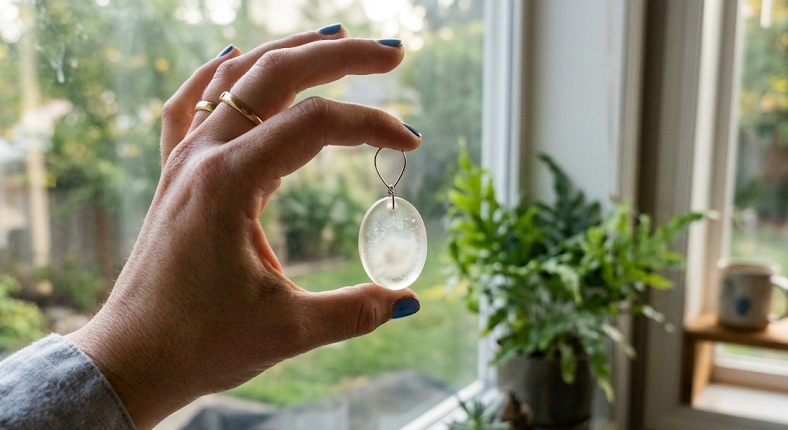
Take the failed piece out of the drawer. Look at it under good light.
If the cloudiness is concentrated near a botanical embed or along the mold edge, moisture is the likely cause. If the piece is soft or tacky anywhere, you had the wrong resin type for your lamp. If the cloudiness is uneven and patchy across the surface, measuring inconsistency is the most likely culprit.
Write down which cause matches what you see. That tells you exactly what needs to change, and whether you need to order anything before your next pour.
For help with pricing your finished pieces once you’re getting consistent results, see the resin jewelry pricing article.
Conclusion
A cloudy resin jewelry fix doesn’t require new equipment or a different workspace. In most cases it requires one small change: drying the mold, switching to the correct resin type, or adding a silicone measuring cup to your prep. The failed pour isn’t a sign that resin jewelry is too technical for you. It’s a sign that one specific variable was off.
Find the variable. Fix it. Your next pour will tell you whether you’ve solved it.
Most people who land on a page like this searching “why is my resin cloudy” are one pour away from a piece they’re satisfied with. The diagnostic work is the only hard part, and you’ve just done it.
Ready to Stop Fixing Failures and Start Selling?
Cloudy resin is a solvable problem. What comes after the fix is a different challenge entirely: picking the right products, setting prices that hold, and building a workflow that doesn’t eat your evenings.
Clear Results is the 30-day plan that takes you from consistent pours to first sale. Every resin type, every tool decision, and every product category that moves on Etsy is covered inside.
Frequently Asked Questions
Why did my resin come out milky even though I followed the instructions?
The instructions on most resin kits cover the cure process, not the prep conditions. A milky or cloudy resin result usually traces back to something that happened before the pour: a damp mold, a wet embed, or a mismatch between your resin type and your curing method.
Can I fix a cloudy resin piece after it’s already cured?
In most cases, no. Once UV resin has fully cured, the cloudiness is locked into the material.
Does humidity in the room cause cloudy resin jewelry?
It can, but it’s less common than moisture from the mold or embed directly. High ambient humidity, above 70 percent, can affect the surface of a pour during cure.
How long should I cure UV resin to avoid cloudiness?
Under-curing produces a tacky or soft result more often than cloudiness. If your piece is fully hard but still cloudy, cure time isn’t the issue. The cause is almost always moisture or a product mismatch.
What wattage UV lamp do I need for resin jewelry?
A 36-watt lamp is the standard minimum for jewelry-scale molds. Lower wattage lamps, such as 6 or 9 watts, can leave resin under-cured in the center of the mold even when the surface appears set.
Is cloudy resin jewelry still sellable?
It depends on the degree and how it reads in the finished piece. A slight frost can sometimes pass as an intentional matte finish on certain designs. Full internal cloudiness is a quality issue and shouldn’t be listed for sale.
Hot Take on Resin Starter Kits
Craft resin kits that don’t clearly label epoxy vs. UV resin should be pulled from shelves. Agree or not?
- Yes. Selling unlabeled resin kits to beginners is negligent.
- No. It’s on the buyer to research what they’re purchasing.
- The manufacturer isn’t the problem. The retailers stacking them next to UV lamps are.
- It doesn’t matter. One bad pour teaches you more than any label ever would.