
At a Glance: Palm Sander vs Orbital Sander for Refinishing Furniture
- Random Orbital Sanders are your go-to for big, flat surfaces like table tops, cabinet doors, and dresser fronts
- Their spinning-and-wiggling motion means you can’t mess up with swirl marks (seriously, they’re beginner-proof!)
- Palm Sanders are the only tool that fits tight corners, chair spindles, and detailed trim work
- Random Orbital Sanders use pricier hook-and-loop discs but remove finish faster and are nearly mistake-proof
- The sanding process: Start with 80-grit to strip old finish, move to 120-grit for leveling, finish with 220-grit for that silky-smooth surface
Want that old money furniture look? The secret is all in the sanding process. Your $40 thrift store dresser can look like a $1,200 heirloom with the right tool and method. Get it wrong and you’ll see swirl marks and uneven patches. Get it right and people will ask where you found such a stunning piece.
This guide compares palm sander vs orbital sander for refinishing furniture and walks you through when to use each tool for that timeless finish.
Why Refinish Furniture?
Refinishing furniture gives you:
- Custom pieces that match your interior.
- Major savings with thrift store finds for $30 that look like $300 pieces
- That proud moment when guests ask “Where’d you get this?” and you say “I made it”
Plus, there’s something seriously satisfying about taking a beat-up piece and bringing it back to life.

- COMPACT DESIGN – Allows access to cramped corners and tight spaces.
- POWERFUL MOTOR – 1.2 Amp motor supplies 14,000 orbits per minute for fast and thorough material...

(As an Amazon Associate, we earn from qualifying purchases.)
The Tool Breakdown: Palm Sander vs. Orbital Sander
Let’s compare these two sanders in terms of features.
| Feature | Palm Sander (Detail King) | Random Orbital (Finish Pro) |
| How It Moves | Vibrates in small circles | Spins AND wiggles randomly |
| Pad Size | 1/4 sheet (about 3×5 inches) | 5″ or 6″ round disc |
| Sandpaper Cost | Regular sheets you cut yourself = cheap! | Special discs with hooks = pricier |
| Perfect For | Corners, spindles, detailed trim | Table tops, flat doors, big surfaces |
| Speed | Fixed (usually 12,000-14,000 OPM) | Variable (7,000-12,000 OPM) |
| Finish Quality | Can leave swirls if you’re not careful | Almost impossible to mess up |
Palm Sander: Your Detail Specialist
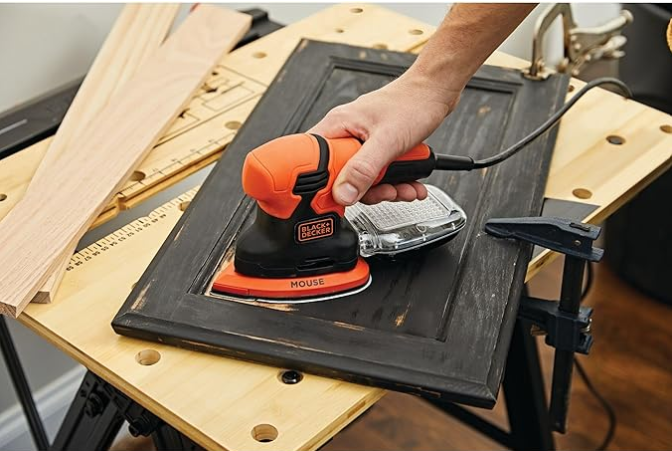
Why you’ll love it: It’s small, easy to control, and gets into spaces the big sander can’t. Plus, it uses regular sandpaper sheets cut into quarters for a major budget win.
The catch: It vibrates a lot and if you let it sit in one spot, you might get circular marks. Keep it moving, and you’ll be fine.
Best move: This is your finishing tool. After the orbital does the heavy lifting, use this for details and touch-ups.
Random Orbital Sander: Your Workhorse
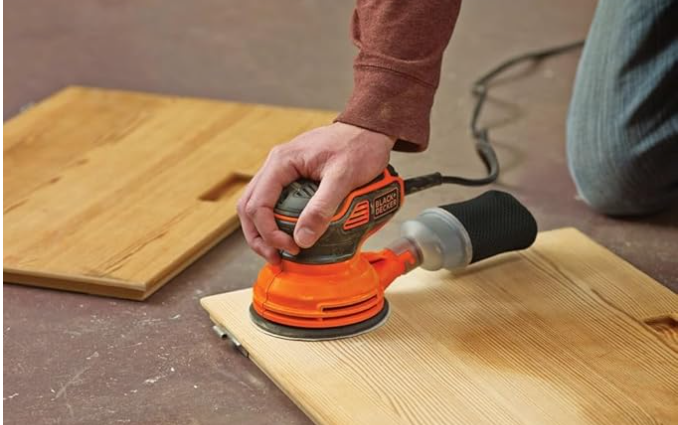
Why you’ll love it: The random motion means you literally cannot create swirl marks. It’s beginner-proof! Plus, it removes old finish FAST. You’ll save hours compared to hand-sanding.
The catch: That round pad can’t reach into corners, and the specialized discs cost more. But honestly? The time you save makes it worth every penny.
Best move: Start every flat surface with this tool. It’ll handle 90% of your furniture refinishing work.

- VERSATILE USE – For paint, varnish, and stain removal, surface preparation, shaping wood...
- COMPACT, ERGONOMIC DESIGN – Handheld sander provides enhanced control when accessing cramped...
Which Sander for Which Project?
When choosing between a palm sander vs orbital sander for refinishing furniture, match the tool to your project type.
Best Sander for Dining Tables
Random Orbital Sander. Flat table tops need swirl-free finishes. The orbital delivers perfect results and removes old varnish in half the time.
Best Sander for Cabinets
Both sanders. Use the Random Orbital for flat door panels. Switch to the Palm Sander for edges, trim, and corners where the big sander won’t fit.
Best Sander for Dressers
Both sanders. Random Orbital handles drawer fronts and top surfaces. Palm Sander tackles legs, decorative trim, and tight corners around hardware.
Best Sander for Chairs
Palm Sander. Chair spindles, curved backs, and intricate legs need the compact palm sander. Use the orbital only if your chair has flat seat surfaces.
How to Transform Furniture Using a Sander
Step 1: Strip the Old Finish (80-Grit)
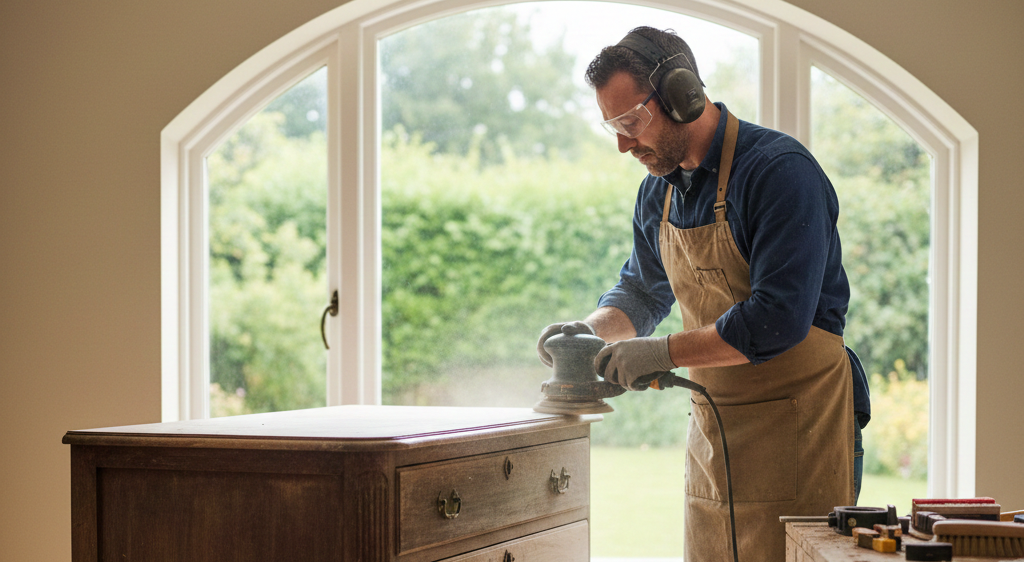
Grab your Random Orbital with 80-grit paper and remove that orange varnish or old paint. Keep the sander flat and moving so you’ll feel when it’s cutting through. Don’t press hard; let the tool do the work.
Step 2: Check Your Work (120-Grit)
Here’s a pro trick: Lightly scribble pencil marks across the wood. Sand with 120-grit until those marks disappear. If they’re gone, your surface is level and ready for the next step. This prevents that “homemade” look.
Step 3: Get Into Details (120-Grit, Palm Sander)
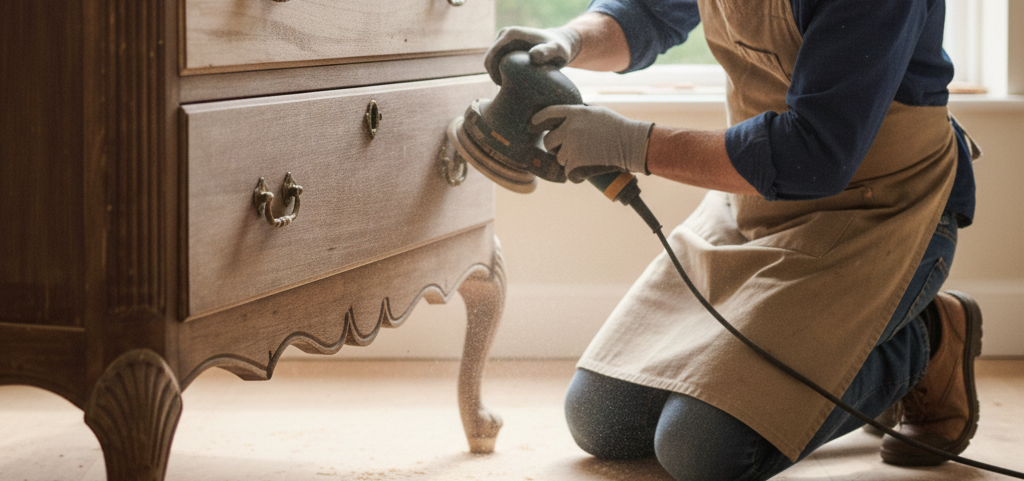
Now switch to your Palm Sander with 120-grit for corners, edges, and trim. Make sure the whole piece has the same texture. This is what separates “DIY project” from “professional refinish.”
Step 4: Final Smooth (220-Grit)
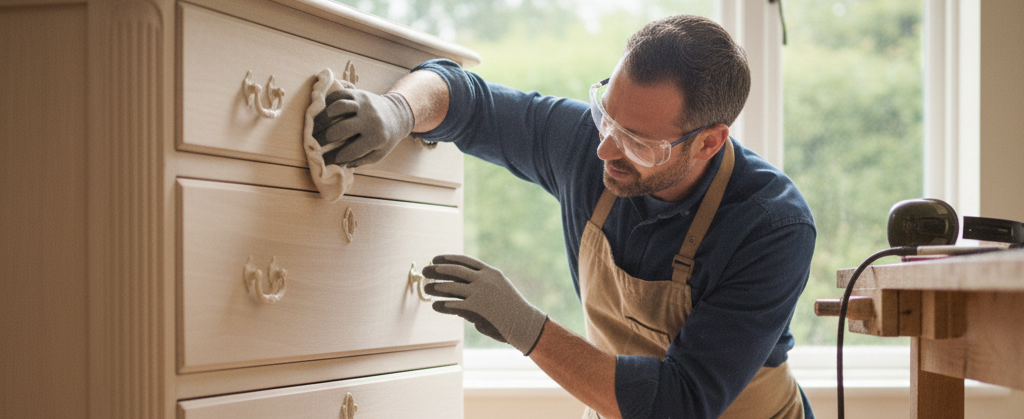
Finish with 220-grit on BOTH sanders (use each where it works best). This creates that silky-smooth surface that makes people say “wow.” Wipe everything down with a tack cloth before staining or sealing.
Invalid table id.You Totally Got This!
Look, we know power tools can feel intimidating. And yes, you might worry about messing up that awesome thrift store find. Just remember that these sanders are designed for beginners, the random orbital literally prevents mistakes, and the palm sander is so easy to control.
Start with a small project like a nightstand or wooden tray. You’ll get the hang of it in minutes, and then you’ll wonder why you didn’t try this sooner.
Quick confidence boosters:
- Keep a magnetic strip on your workbench for scrapers and tools
- Label your sandpaper grits so you don’t grab the wrong one
- Don’t forget to take photos to see how far you’ve come!

- PRACTICAL DESIGN: 50PCS Sanding Pads with Extra Tips for replacement, 5-1/4" x 3-3/4" (13.5cm x...
- GOOD SANDING EFFECT: High Quality Aluminum Oxide Sanding Sheets with good property: durable...
Show Us Your Project!
Seriously, we want to see what you create. That beat-up dresser you transformed? The dining table you rescued? Share your photos and tag us because there’s nothing better than celebrating your finished piece with this community.
Now go turn that furniture into something beautiful!
FAQs: Palm Sander vs Orbital Sander for Refinishing Furniture
What’s the difference between a palm sander and an orbital sander for refinishing furniture?
A palm sander uses a fixed circular vibration and is compact for detail work in tight corners and trim. A random orbital sander combines spinning and random oscillation for larger flat surfaces, delivering a swirl-free finish on table tops and cabinet doors.
Can I use just one sander for all furniture refinishing projects?
No, most furniture projects require both sanders. Random orbital sanders handle large flat surfaces like table tops and dresser fronts, while palm sanders are essential for corners, spindles, and detailed trim work that the larger orbital sander can’t reach.
Which sander is better for refinishing dining tables?
A random orbital sander is the best choice for refinishing dining tables. Its random motion prevents swirl marks on flat surfaces and removes old varnish twice as fast as a palm sander, giving you professional-looking results on large table tops.
Do palm sanders or orbital sanders leave a better finish on furniture?
Random orbital sanders leave a better finish on flat surfaces because their random motion prevents visible swirl marks. Palm sanders can leave circular “pigtail” marks if not kept moving, but they’re necessary for corners and details where orbital sanders won’t fit.
What type of sandpaper do palm sanders and orbital sanders use?
Palm sanders use standard sandpaper sheets cut into quarters, which is budget-friendly. Random orbital sanders require specialized hook-and-loop discs that cost more but save time with quick changes and faster material removal on furniture projects.